
THE FAILSAFE DISPATCH
Practical Business Automation & AI Insights for SME Leaders
6 October 2026 ISSUE #04
The Failsafe Dispatch, Issue #04. Also available as a print-friendly two-page PDF.
Download the PDFIssue #04 · AI capability & controls
AI can do more than ever. Are your controls keeping up?
September was a busy month for AI in business. New agent platforms take on ongoing responsibilities and act across applications. AI tools gained live access to accounting data. And a major accounting software provider solved a real operational problem without AI at all.
Together they show AI becoming more able to act, not just generate information. That is genuine opportunity, but it changes the questions a business should ask about control, access and autonomy.
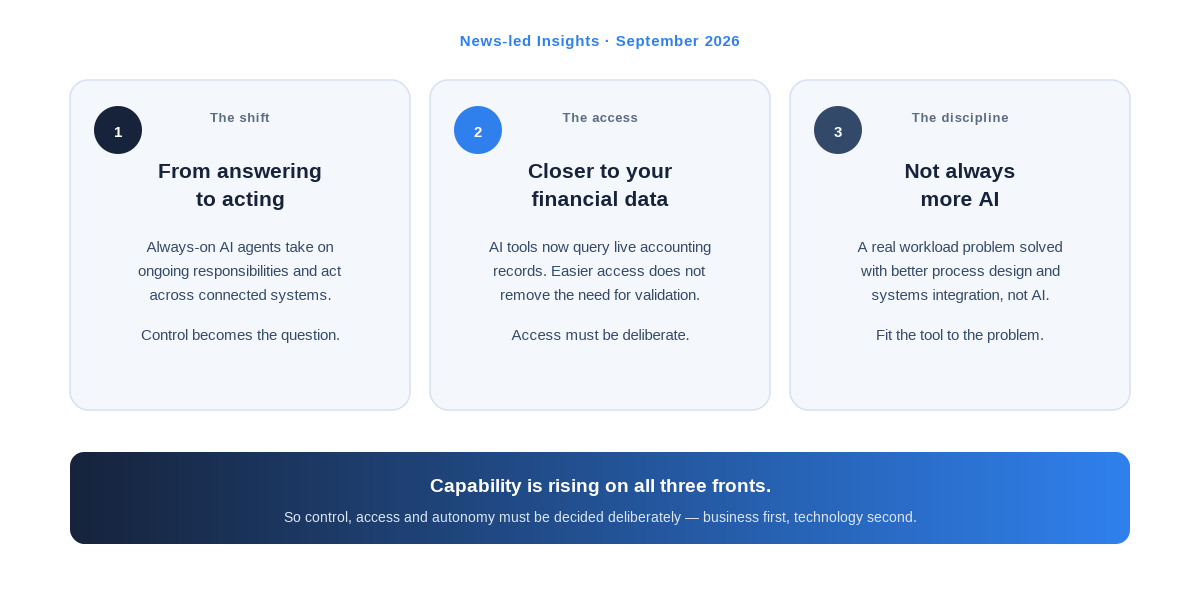
Three September 2026 developments, one discipline: control, access and autonomy must be decided deliberately.
1. AI is moving from answering to acting
On 29 September 2026, OpenAI announced "Dots" at its annual DevDay conference: always-on AI agents that take on ongoing responsibilities, connect to over 4,000 applications and work towards goals around the clock. Dots have their own cloud computer and can act across connected systems; the Agents API now lets developers build agents that interact directly with software.
Until now, AI produced an output and a person decided what to do with it. Agents carry out multi-step tasks without direct supervision, shifting the control question from "is the answer accurate?" to: what can it access? What can it do? Which actions need approval?
This is a business-process design question, not only an IT one. OpenAI has built approval controls and permission settings into Dots, but deciding how much autonomy each process warrants sits with the business.
2. AI is getting closer to your financial data
On 16 September 2026, Xero announced that its ChatGPT plugin is live and expanded its Anthropic integration through "Claude for Small Business," supporting workflows such as overdue invoice chasing, cash flow snapshots and month-end preparation, all using live Xero data. Separately, on 7 September, the ICAEW published guidance on validating AI-generated content, advising accountants to "treat AI as a starting point for research, not the final authority."
AI tools can now query live profit and loss data, balance sheets, invoices and bills directly from accounting software, which could reduce administrative work. But easier access does not remove the need for validation. The ICAEW is direct: AI-generated content "can also produce inaccurate, outdated or entirely fabricated information, often presented with complete confidence." Xero's integrations are read-only and data sharing is off by default. The professional question remains: which outputs can be used directly, and which require a qualified person to verify them?
3. Sometimes the right answer is not more AI
On 15 September 2026, Sage announced Period Review: a tool that brings client transaction data from Sage Sole Trader and supported banking apps into one review workflow, so accountants can search, sort and correct transactions, apply bulk actions and submit updates without moving between tools. HMRC-commissioned research found that 86% of tax agents anticipated additional tasks to support client compliance with Making Tax Digital.
This is deliberately the counterbalance. Period Review addresses the growing MTD workload through better process design and systems integration, not AI. The question is not "where can we apply AI?" but "what is the most effective way to solve this problem?" Sometimes the right answer is not more AI.