
Your operations manager brings you a proposal. She's found an AI tool that promises to streamline client onboarding — scan documents, extract data, populate your practice management system, send welcome emails. The demo looks impressive. The ROI calculator shows you'll recoup the investment in six months.
So the question seems straightforward: can we automate this?
But then your compliance lead asks where the client data is going. Your IT person asks how it integrates with your existing systems. Your head of tax asks whether the AI will flag regulated activities correctly. Your data protection officer asks about processing records and individual rights.
Suddenly the question has changed. It's no longer "Can we automate client onboarding?" It's "Should we automate this process? Which parts? What controls must remain? Where is human judgement still required? Where is client information actually going?"
This is the AI governance question every accountancy practice is facing right now. And the firms getting it right aren't starting with the AI tool. They're starting with the process.
The Evidence: Why Governance Matters in Accountancy
Accountancy practices face significant AI opportunities. High manual task loads, document-heavy workflows, and repetitive compliance tasks make automation attractive. Professional bodies acknowledge this: the FRC published guidance in March 2026 to help audit firms adopt AI "with confidence," describing it as designed to support innovation while maintaining standards.
But accountancy also carries particular responsibilities. Three layers of obligation apply:
Professional ethics. Members of professional bodies (ICAEW, ACCA, ICAS, CIPFA and others) must comply with five fundamental principles: Integrity, Objectivity, Professional Competence and Due Care, Confidentiality, and Professional Behaviour. These principles apply to AI use just as they apply to every other professional activity. The Consultative Committee of Accountancy Bodies published draft guidance in July 2026 examining how these principles apply when professional accountants develop, deploy or use AI tools. While this remains consultation material, it reflects emerging professional expectations: AI does not diminish personal responsibility or accountability.
Data protection. Accountancy practices routinely process personal data when serving clients. Where that processing occurs through AI tools, UK data protection obligations apply: lawfulness, fairness, transparency, accuracy, purpose limitation, data minimisation, and integrity. The ICO's 2023 guidance on AI and data protection (currently under review following the Data (Use and Access) Act) explains how these principles apply to AI. Data protection is not an optional compliance exercise — it is a statutory baseline for organisations processing personal data.
Conditional obligations. If your practice conducts statutory audits, the FRC's March 2026 Generative and Agentic AI Guidance — the first from any audit regulator globally — offers a framework for obtaining appropriate confidence in AI tool outputs while maintaining ISQM (UK) 1 quality management obligations. The guidance reinforces that "the human auditor is always accountable." If your practice advises on UK tax matters, PCRT guidance published in January 2026 by seven professional bodies applies the PCRT fundamental principles to AI tools.
These aren't abstract regulatory hurdles. They are the foundations of client trust and public confidence in the profession.
The Central Governance Principle
The FRC's March 2026 guidance stated it explicitly: "Regulatory accountability for the deployment of AI tools and the quality of audit outputs remains unchanged. As set out in auditing standards, the human auditor is always accountable."
The CCAB's draft guidance to the profession made the same point: "Professional accountants cannot abdicate responsibility for outputs produced by their use of AI tools and systems."
This is the central principle: while technology evolves, professional accountability and regulatory responsibility remain constant.
And this is actually good news. It means your firm controls its own governance. You are not waiting for a regulator to approve your AI adoption. You are determining — based on your understanding of your processes, your data, your controls and your professional obligations — which AI opportunities are appropriate and implementable safely.
But here's the challenge: the CCAB's draft consultation material identifies seven commonly documented ethical risks that arise when firms deploy AI without first understanding the processes it will operate within: algorithmic bias, automation bias (favouring automated outputs over human reasoning), data privacy and confidentiality breaches, erosion of professional judgement, hallucinations (AI producing plausible but incorrect outputs), opacity (the "black box" problem), and unclear accountability.
These risks are real and documented by professional bodies. But they are also manageable — if you understand the process first.
The Failsafe Interpretation: Start with the Process, Not the Tool
Most practices approach AI adoption by evaluating tools. They attend webinars, request demos, compare features and pricing. The conversation is: "Which AI platform should we buy?"
Failsafe's approach is different. We start with the question: "What business outcome are you trying to achieve, and is AI the right way to achieve it?"
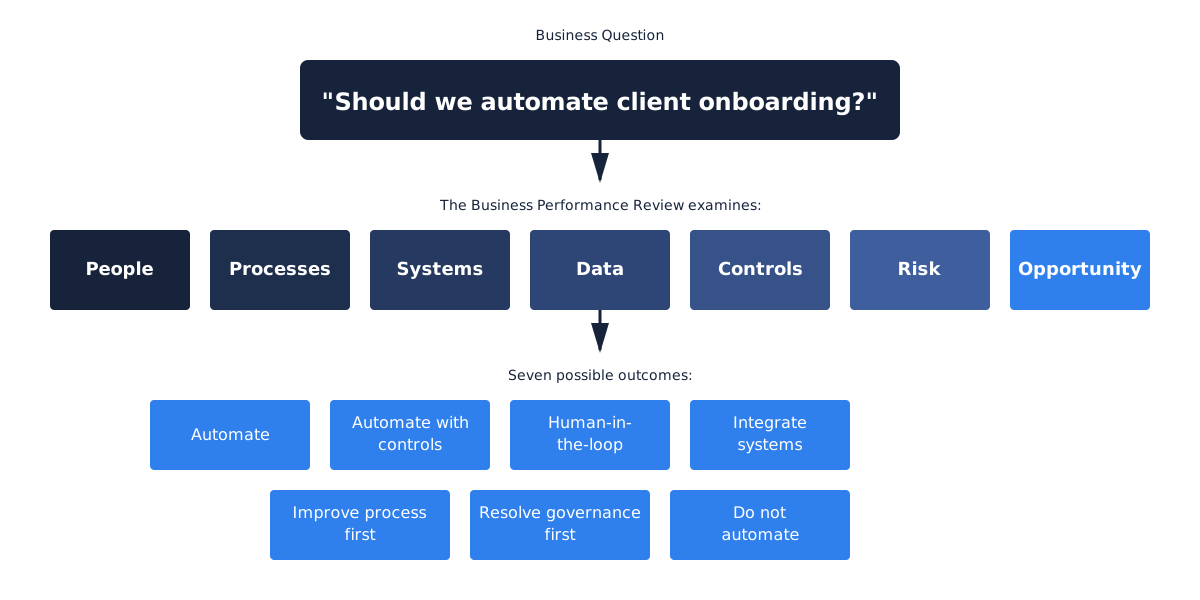
This is the Business → Operations → Technology → AI reading order that runs through every Failsafe engagement. Before asking "Which AI tool?", we examine the operational foundations:
People. Who is accountable for this process? Who will provide oversight of the AI outputs? Where is professional judgement required?
Processes. Is the process standardised? Who owns it? Have you documented it? A broken process automated is still a broken process — and now harder to fix.
Systems. What systems does the AI need to interact with? How does data flow between them? Where are the integration points?
Data. Where does client data go when you use this tool? What happens to it? Is it used for training? Does it leave your control? What is the data quality feeding the AI?
Controls. What controls must remain in place? What checks are non-negotiable? Where must a human review the output before it is relied upon or sent to a client?
Risk. What are the ethical risks? The regulatory risks? The reputational risks if the AI produces an incorrect output that affects a client?
Opportunity. Now — and only now — which AI opportunity is commercially valuable, professionally appropriate, and implementable safely?
This is not a separate "AI governance framework." It is how the Business Performance Review already examines every process in your practice. The difference is that firms conducting a BPR are already doing the governance work required for responsible AI adoption — whether or not AI is on the agenda yet.
The Framework: Seven Decision Outcomes
When you examine a process through this lens, the outcome is not always "automate." In fact, Failsafe does not enter an engagement looking for things to automate. We determine the most appropriate business outcome. Seven outcomes are possible:
1. Automate.
The process is standardised, owned, and low-risk. Data quality is high. The AI opportunity is commercially valuable and professionally appropriate. You have the integration capability and the governance controls in place. Automate it.
2. Automate with controls.
The process is suitable for automation, but human oversight is required. For example: AI drafts a document, but a qualified accountant reviews and approves it before it is issued to a client. This is the "human-in-the-loop" approach the CCAB's draft guidance and FRC guidance both reference as a key safeguard.
3. Human-in-the-loop (shared decision-making).
The AI assists, but does not decide. For example: AI flags unusual journal entries for review, but the auditor makes the professional judgement whether further investigation is warranted.
4. Integrate systems.
Sometimes the problem is not that a process needs automating — it's that systems don't talk to each other. Removing a manual handoff by integrating your practice management system with your client portal may be more valuable than adding AI.
5. Improve the process first.
The process is not standardised. Ownership is unclear. Data quality is poor. Automating it now would bake in inefficiency and create new risks. Improve the process first, then revisit the AI opportunity.
6. Resolve governance first.
The AI opportunity is attractive, but governance gaps exist. For example: you have not documented where client data will be processed, or you have not conducted the required data protection impact assessment. Resolve governance first, then implement.
7. Do not automate.
The risk is too high, or human judgement is too central to the process. Not every professional activity should be automated. The CCAB's draft guidance notes that where threats to compliance with fundamental principles cannot be eliminated or reduced to an acceptable level through safeguards, the activity must be declined or discontinued.
This is what responsible AI adoption looks like. Governance does not stop innovation. It gives you the confidence to adopt AI where it is appropriate, and the clarity to say no where it is not.
The Role of the Business Performance Review
The Business Performance Review examines every process in your practice across people, processes, systems, data, controls, risk and operational resilience. It produces a structured digital business record documenting how your practice operates — and where improvement opportunities exist.
When a practice has completed a BPR, much of the operational groundwork for a more informed AI governance conversation is already in place. You know which processes are standardised, where data quality is strong or weak, how systems integrate, where controls are effective and where gaps exist, who owns each process, and what your current operational resilience looks like.
The AI question then becomes: "Given what we now know about our operations, which AI opportunities are commercially valuable, professionally appropriate, and can be implemented within the obligations that apply?"
You are not adopting AI to fix operational problems you have not yet diagnosed. You are selecting AI opportunities that build on a solid operational foundation — and that can be implemented within your professional, regulatory and data protection obligations.
This is Business → Operations → Technology → AI. It is the reading order that ensures technology serves the business, not the other way around.
Next Steps
If your practice is considering AI adoption, three questions are worth answering before you commit to a tool:
1. Do you understand the process the AI will operate within?
Can you describe how the process works today, who owns it, what systems it touches, where data flows, and what controls are in place?
2. Do you know where client data will go?
Can you answer your data protection officer's questions about legal basis, processing location, retention, individual rights, and whether the AI provider will use your data for training?
3. Have you identified which governance obligations apply?
Professional ethics apply to all members. UK data protection law applies where you are processing personal data. Conditional obligations (audit, tax) apply depending on the services your practice provides.
If you cannot answer these questions confidently, the AI conversation may be premature. The opportunity is to understand your operations first — then select the AI tools that are commercially valuable, professionally appropriate, and implementable safely.
Governance does not stop AI adoption. It enables confident adoption. And the practices getting it right are the ones starting with the process, not the tool.